Kane’s “Underground Flying Mail,” the NPM exhibition “Pneumatic Tube Mail,” the object-spotlight essay, and the museum’s canister video all say the New York canister could hold up to 600 letters. A Smithsonian Snapshot on the same object (12 October 2011) and the NPM “Unusual Delivery Methods” caption say up to 500. Smithsonian Magazine (Armstrong, 2023), citing museum context, also describes cylinders that “could hold around 400 letters.” Those are three published Smithsonian-family numbers.
United States Post Office Department · Tubular Dispatch Company
New York, 1897–1953.
Smithsonian National Postal Museum captions, and closely related Smithsonian captions, supply the figures. Those captions disagree with each other on letter count and speed.
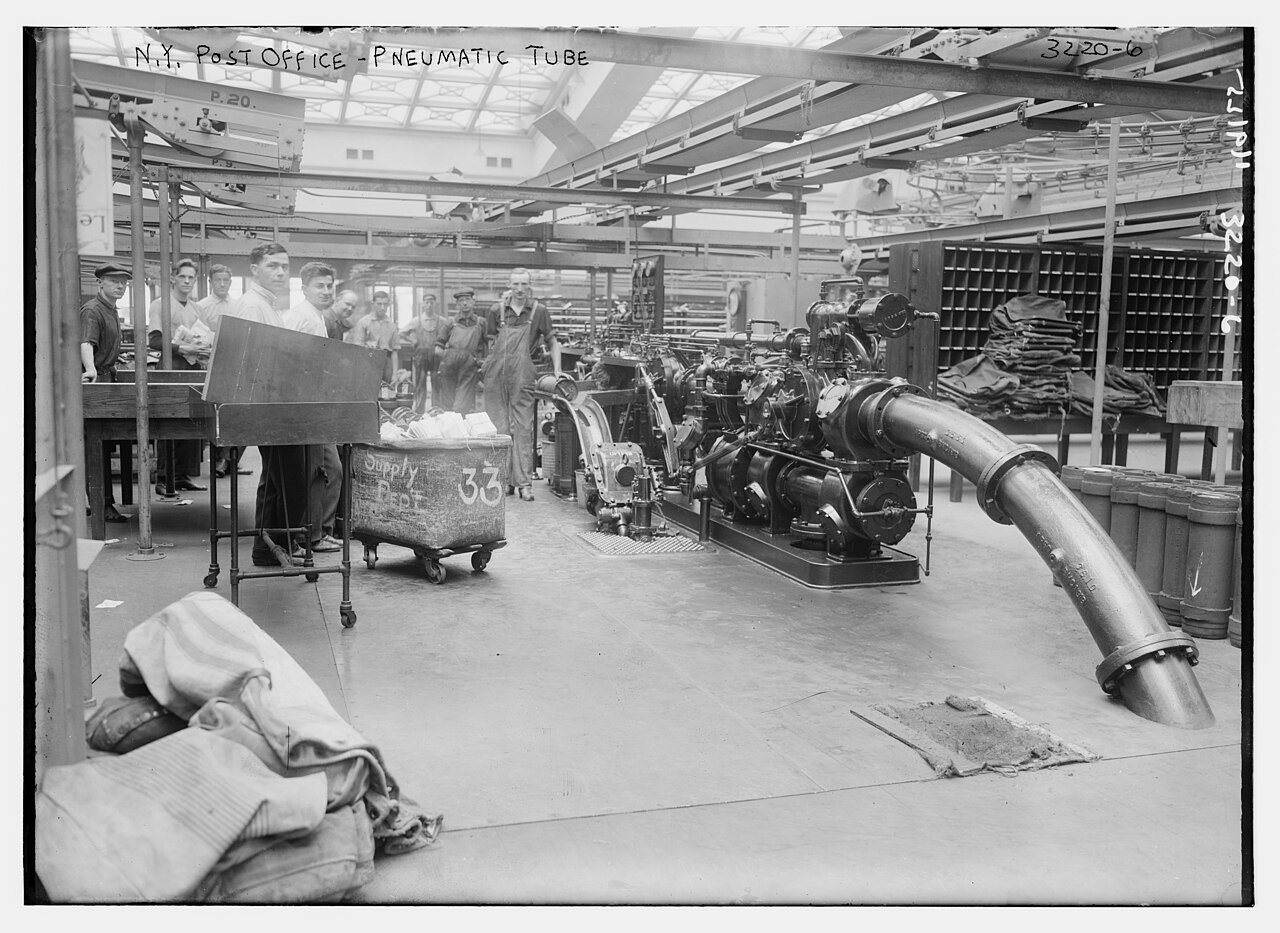
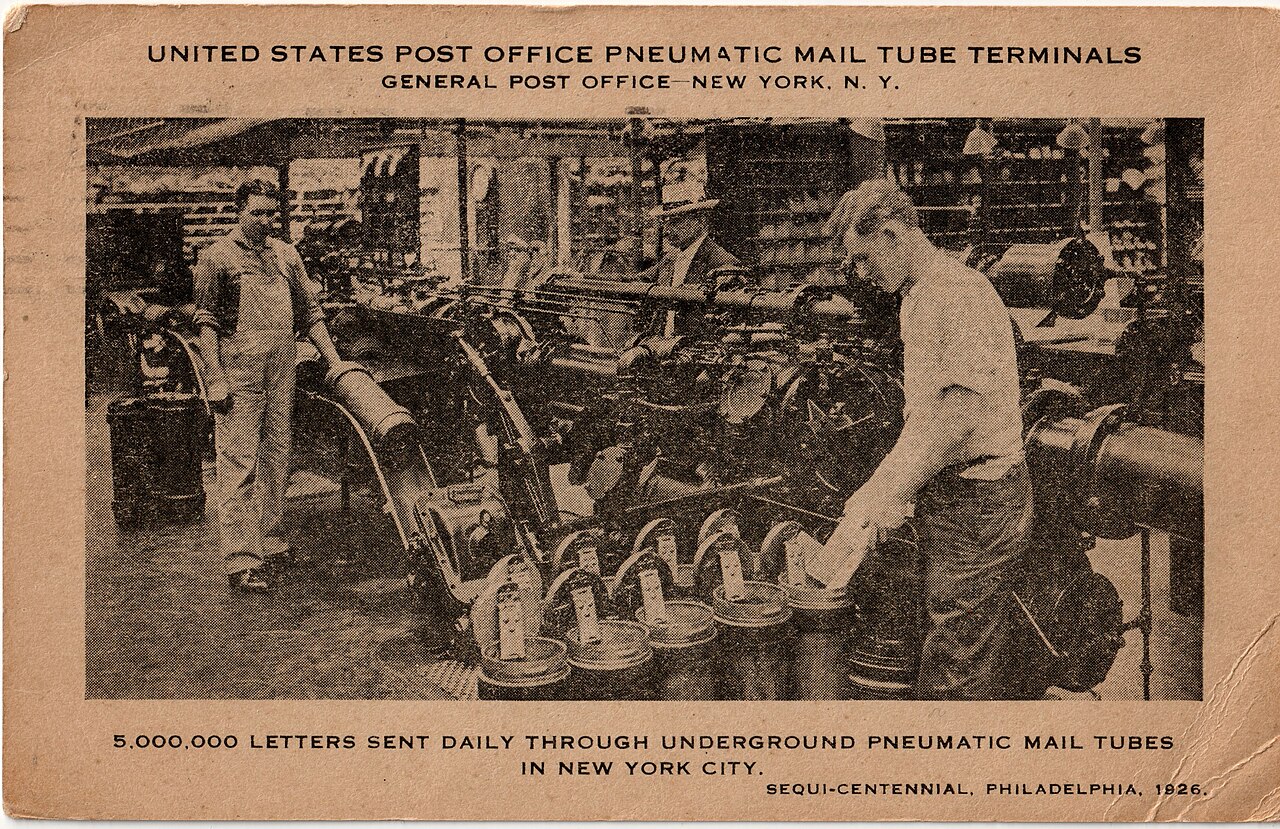
New York City began using pneumatic tubes in 1897. Allen Kane, writing as a former director of the National Postal Museum, gives the original underground line as running between the main post office building and Station P in the Produce Exchange building. The Tubular Dispatch Company manufactured the tubes and rented them to the Post Office Department for an annual fee of $148,500. An above-ground section, attached to the Brooklyn Bridge, connected Manhattan and Brooklyn offices.
The Smithsonian object record for the museum’s canister repeats those sentences and adds a 1898 snapshot: by then the system connected twenty-one local post offices in Manhattan to the main post office. As late as 1914, 30 percent of first-class letters sent through the city’s main post office were transmitted by pneumatic tube.
The Post Office Department suspended the New York service in 1953, pending review, and never reinstated it. A separate National Postal Museum caption dates the last day more tightly: the New York pneumatic tube ceased operation on 31 December 1953.
| Claim | As written by |
|---|---|
| Opened 1897; original line main PO ↔ Station P (Produce Exchange) | Kane / NPM; SI object npm_0.269514.1 |
| Annual rent $148,500 (Tubular Dispatch Co.) | Kane / SI object |
| 21 Manhattan local offices connected by 1898 | SI object |
| 30% of first-class through the main PO by tube, 1914 | Kane / SI object |
| Canister 24½ × 8¼ in (62.23 × 20.96 cm) | SI object (gift of Lamson Corporation; dated 1953) |
| “As many as six hundred letters” and “about thirty-five miles per hour” | Kane; NPM canister video; NPM city-free-delivery exhibition |
| “Up to 500 letters” and “30 miles per hour” | NPM “Unusual Delivery Methods” caption |
| Six U.S. cities, “more than 56 miles” by 1915 | NPM city-free-delivery exhibition |
| “Eventually, New York City would be covered by 27 miles of pneumatic tubes.” | NPM object-spotlight essay |
| Forty-minute mail-wagon route covered in seven minutes | NPM city-free-delivery exhibition |
| Brooklyn–Manhattan service discontinued April 1950 (bridge repairs), never restored | NPM object-spotlight essay |
Figures as written by those Smithsonian / National Postal Museum sources.
Where captions disagree
500 or 600 letters. 30 or 35 mph.
The National Postal Museum published both pairs.
Kane and the main NPM exhibition: about / average 35 miles per hour, and separately “as fast as 35.” Unusual Delivery Methods: 30 miles per hour. Smithsonian Magazine: 30 mph for the 2-foot, 8-inch, 21-pound empty cylinder it describes. There is no independent dynamometer series. There is also no “typical U.S. tube speed” beyond those captions.
War, trucks, suspension
The line could not move when the city did.
Philadelphia introduced the first U.S. postal pneumatic tubes in 1893. Boston, Brooklyn, New York, Chicago, and St. Louis followed. By 1915, the National Postal Museum’s city-free-delivery exhibition says, those six cities had more than fifty-six miles of tubes. During World War I the Department suspended the service to conserve funding. After the war it restored service in New York and Boston.
Kane’s account of the ending is treated as canonical for New York: automobiles replaced horse-drawn wagons and could move mail between railway stations and post offices even faster than the tubes; post offices and business centers moved with relative ease; the underground system did not. New York continued using a portion of the service into the 1950s. The Department suspended it in 1953 pending review and never brought it back.
Smithsonian Magazine quotes the Department’s 31 December 1953 language: the service was “obsolete, unnecessary and excessively expensive.” The NPM object-spotlight essay adds the Brooklyn Bridge detail: service between Brooklyn and New York City was discontinued in April 1950 because of repairs on the bridge and was never restored.
A Smithsonian Magazine narrative of the 7 October 1897 test — Bible wrapped in a flag, Constitution, McKinley’s inaugural, a live cat, eggs — is Smithsonian-published color, not an NPM measurement or a speed trial.
Philadelphia: first U.S. postal pneumatic line (NPM).
New York service begins. Original line: main post office to Station P, Produce Exchange (Kane / SI).
Twenty-one Manhattan local offices connected (SI object). Brooklyn contract costs given as a range in the NPM spotlight essay.
30% of first-class through the main post office by tube (Kane).
Six cities, more than 56 miles combined (NPM exhibition).
Service suspended; later restored in New York and Boston (NPM).
Brooklyn–Manhattan bridge line discontinued, not restored (NPM spotlight).
Boston ends (NPM Unusual Delivery Methods).
New York ceases; never reinstated (NPM Intra-City Mail; Kane).